

What we know of the two thousand years since PIE is only through archaeology, and that is sparse. Corded ware pottery is the main artefact. The emergence into history of Germanic-speaking peoples as a major force may be dated from the victory over Rome of Arminius in 9 CE. He commanded an alliance of five out of the fifty Germanic tribes at the Battle of the Teutoburg Forest, in which three Roman legions were destroyed. The first Germanic writing is the Gothic bible around 350CE. The migration of West Germanic tribes to the British Isles started around 450CE. Norse religion, and Christian attempts to draw people away from it, is one of our sources for this period.

Dream of the Rood
Caedmon’s hymn was written down in Northumbrian between 638-680 and may be the earliest text in what would become Scots. Caedmon uses Frēa, Uuldurfadur and Metud for God (also Dryhten), and middungeard for Earth. This suggests that the earliest Christians still thought in old Germanic theology.
Nū scylun hergan hefaenrīcaes Uard,
metudæs maecti end his mōdgidanc,
uerc Uuldurfadur, suē hē uundra gihuaes,
ēci dryctin ōr āstelidæ
hē ǣrist scōp aelda barnum
heben til hrōfe, hāleg scepen.
Thā middungeard moncynnæs Uard,
eci Dryctin, æfter tīadæ
fīrum foldu, Frēa allmectig.
The dream of the rood seems to adapt Odin’s self-sacrifice story to that of of Jesus’ crucifixion. It is a missionary statement from Christians to those who still followed the old gods. The narrator is the tree (rood, crucifix). It comes down to us through the much later 9th century West Saxon.
Odin’s sacrifice on the tree, which is the world tree Yggdrasil (Ygg and Grim were nicknames for Odin. It was a self-imposed ordeal to gain knowledge of the runes. He hung himself from a branch for nine days and nights, wounding himself with his spear, and peered into the waters below. During this time, he endured suffering to prove himself worthy of receiving the runes, which were then revealed to him in the depths of the waters
| Onġyrede hine þā ġeong hæleð – þæt wæs God ælmihtiġ, strang ond stīðmōd. Ġestāh hē on ġealgan hēanne, mōdiġ on maniġra ġesyhðe, þā hē wolde mancyn lȳsan. Bifode iċ þā mē se beorn ymbclypte. Ne dorste iċ hwæðre būgan tō eorðan, feallan tō foldan scēatum, ac iċ sceolde fæste standan. Rōd wæs iċ ārǣred. Āhōf iċ rīċne Cyning, heofona Hlāford, hyldan mē ne dorste. | “The young warrior stripped himself then—that was God Almighty— strong and firm of purpose—he climbed up onto the high gallows, magnificent in the sight of many. Then he wished to redeem mankind. I quaked when the warrior embraced me— yet I dared not bow to the ground, collapse to earthly regions, but I had to stand there firm. The rood was reared. I heaved the mighty king, the Lord of Heaven—I dared not topple or reel. |
You will need http://www.oldenglishaerobics.net/dream.php to follow the OE; every word has hyperlinks to MnE.
The Ruthwell Cross in Scotland is about The Dream of the Rood. In it the crucifix (rood) tells its experience of a heroic Jesus. The runes were added in the 8th century, perhaps to speak to those still resisting Christian conversion.


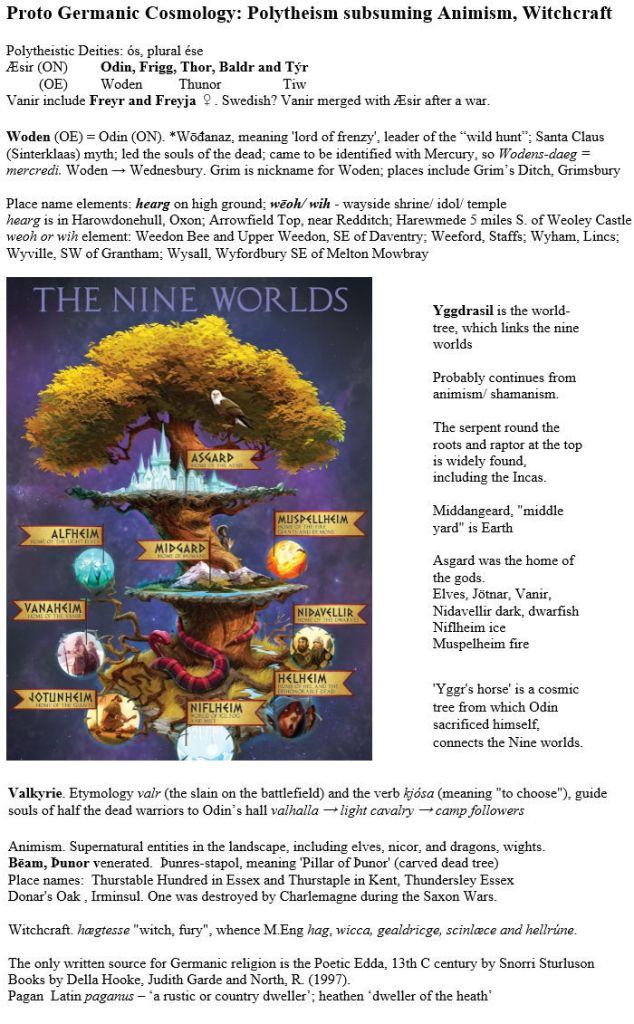
Veneration of trees (bēam) and carved dead trees, “pillar of Þunor” (Þunres-stapol) might be described as a continuing Animistic feature of the mainly Polytheist Germanic religion. Tolkien includes trees as sentient mobile beings in the Lord of the Rings series. Cosmology was represented by Yggdrasil, the world-tree, which connects humans in Middengeard with gods in Asgard and seven other levels to make nine worlds in total. English village names such as Thunderley record a thunor. The Elder Futhark (named after the initial phoneme of the first six rune names: F, U, Þ, A, R and K) has 24 runes, often arranged in three groups of eight runes:


Translating Roman back to Germanic
Goths probably meant both the Geats of southern Sweden and Gutes of Gotland. Their name comes from the PIE root *ǵʰewd- meaning “to pour”, possibly meaning “seed-spreaders”.
Auster Goths migrated to the Balkans, so they were called “eastern”.
H₁wésus – Geats were introduced to Latin readers by Cassiodorus as “Visigoths”, under the misapprehension that meant “west Goths”. Under Alaric they sacked Rome in 410.
Þeudo-rīks means ‘people-ruler’ in Proto Germanic but Romans gave it a form that appears Greek – “Theoderic”. Many personal names across Europe derive from this, including Dietrich, Thierry, Dirk etc. The most famous bearer of the name was Þeudo-rīks the Great, king of both the Austro Goths and Visigoths from 454-526.
Wandale, ‘roamers’ (pronounce it -a -le) were changed to “Vandals” by Romans. They were first recorded in the Przeworsk Iron Age culture 5th – 3rd C BCE in Southern Poland. They migrated west with Roman permission to escape Hun raids and reached Iberia. They fended off Rome several times and sacked it in 455, before destruction by Justinian in 533.
“Germanic”
The North Germanic branch are Scandinavians (excluding Finns). The West Germanic branch are Dutch, High German, English, but not “Huns”. This derogatory term for Germans was popularized by Rudyard Kipling, but that tribe entered from central Asia around 370. The following three sentences mean the same thing in three other Germanic cousins. Can you identify the languages?
Ikh hob a bruder aun tsvey shvester. ven meyn muter aun fater zenen lebedik meyn froy halb zuntik lontsh far zibn mentshn.
Ik haw in broer en twa susters. Doe’t myn mem en heit libbe, kookde myn frou sneintemiddei foar sân minsken.
Ek het ‘n broer en twee susters. Toe my ma en pa gelewe het, het my vrou Sondagmiddagete vir sewe mense gekook.
An interesting sound change in Germanic languages is the sound /g/. The Angles arrived soon after 450 CE saying a voiced glottal stop, so Bede wrote in 730 with the letter ‘g’. By Alfred’s time around 890 it had changed. ‘Monndæg’ was pronounced like modern ‘Monday’. Scribes introduced a dot – ġ – to show that the letter ‘g’ was no longer orthographic. ‘Kirk’ had changed to ‘church’ so letter written ‘c’ was also dotted – ċ. Scots English is more conservative and retains ‘kirk’.
The reasons for phonological change are always difficult to explain, but a plausible hypothesis is our left-headed stress often means that the end of a word carries no information and is prone to elision. The actual phonemes can be transcribed by https://tophonetics.com/. From Proto Germanic to Old English and Modern English the reduction of the phonemes seem to be: ⟨mɒndeɪg⟩ → ⟨mʌndeɪ⟩ → ⟨mʌndɪ⟩, ⟨kɜːk⟩ → ⟨ʧɜːʧ⟩
Similar diachronic changes occur in other Germanic languages. Can you pronounce ‘Göteborg’ the Swedish way and ‘Belgie’ the Flemish way?